Monday, December 20, 2010

The House of Representatives will subvert your rights to quality food tomorrow (12/21) unless . . .

. . . Unless you and thousands of others scream your heads off.

To quote John F. Tate, president of Campaign for Liberty,
On Sunday evening, Harry Reid and Mitch McConnell conjured up a backroom deal to revive the so-called “Food Safety Modernization Act” – passing it by unanimous consent after it was thought dead.

Even though dozens of Republican senators opposed the bill only a few weeks ago, not one member – not even Tom Coburn, who led the opposition to the regulatory boondoggle – dared speak up to oppose the FDA’s food takeover.
This is truly outrageous!

They shoved it into HR 2751, what used to be known as the "Cash for Clunkers" bill. They gutted HR 2751 as it was written, and "simply" substituted S510! So the "new" HR 2751 may (indeed, probably will) come up for a vote as early as tomorrow (Tuesday).

Tate commented,
Liberty is never more in danger than when legislators are looking to cut a quick deal, and last night was another harsh reminder of this fact.

It only required one senator to speak up and object to further empowering [the current Congress'] radical regulatory agenda to bury the bill.
But that was not to be.

Main problems with the bill: As noted in the past, it gives the FDA unbridled authority to shut down virtually any farm operation merely on the basis that some bureaucrat somewhere had "reason to believe" that something on the farm might be harmful. No judicial review. No appropriate due process. Just suspicion.

And look whose "beliefs" will control your food supply if the act passes tomorrow!

As the Farm-to-Consumer Legal Defense Fund noted this morning:
[The] FDA does not respect individuals' rights to obtain healthy, quality foods of their choice. The agency has stated as a matter of public record, that . . . "There is no absolute right to consume or feed children any particular food."
Indeed, when a group of citizens sued the FDA for the right to drink raw milk, the FDA replied,
"Plaintiffs' assertion of a 'fundamental right to their own bodily and physical health, which includes what foods they do and do not choose to consume for themselves and their families' is . . . unavailing because plaintiffs do not have a fundamental right to obtain any food they wish."
More to the point of the bill itself, however, consider, please, that,
The Act does nothing to address [the worst] food safety problems in this country, such as those resulting from confined animal feeding operations (CAFOs), genetically modified organisms (GMOs), and various contaminants (e.g., BPA, pesticides, herbicides, etc.).
The FDA has shown that it cares very little about these significant and proven sources of danger. It refused to go after the egg producer whose half-billion tainted eggs became the rallying cry for those who claim we need the bill. It has been well aware of this producer's problems for years. But it maintains a rather hands-off approach to them. After all, it's a big producer and it employs a lot of people.

Meanwhile, it makes sure to pursue every minor problem it hears about on small farms and among raw and unprocessed food advocates. (See my post with a whole series of sample videos.)

Notice that the agency
has used its existing power to benefit the pharmaceutical and biotechnology industries at the expense of public health (e.g., allowing the overuse of antibiotics in confined animal feeding operations and refusing to require labeling for genetically-modified foods). This Act does not address the fundamental problems at this agency in order to truly protect public health.
Moroever,
[The] FDA has adequate powers under existing law to ensure food safety and effectively deal with foodborne illness outbreaks. FDA has power to inspect, power to detain product and can readily obtain court orders to seize adulterated or misbranded food products or enjoin them from being sold. The problem isn't that FDA needs more power; it's that FDA does not effectively use the power it currently has. The agency has power to inspect imported food yet inspects only 1% of food coming into this country from outside our borders.
From a constitutional perspective:
The Act will expand FDA's involvement in regulating food in intra-state commerce, further interfering with local communities. State and local governments are more than capable of handling any problems related to food in intrastate commerce. All the major outbreaks of foodborne illness involve either imported food or food in inter-state commerce.
And from a practical perspective:
The Act will hurt our ability as a nation to be self-sufficient in food production because it has more lenient inspection requirements for foreign than domestic producers creating an unfair advantage for food imports. Giving an advantage to foreign producers will only increase the amount of food imported into this country that does not meet our domestic standards. The Act does not address food security--the ability of a country to produce enough food to meet its own needs.
Please contact your Representative first thing Tuesday morning.

I just used the petition capacity of DemocracyInAction.org to send a modified version of their standard anti HR 2751 letter to my representative:
Sir:

While there is no question that food safety has been lacking at the large, multi-million-dollar corporate food producers, HR 2751, the so-called "Food Safety Modernization Act" creates unbelievably burdensome requirements for thousands of small family farmers who exceed $500,000 in mere food REVENUE, whether they make a profit in the end or not.

As a small business owner myself, and a fan of our local farmers' market, I am appalled at this notorious attempt by Big Ag to stifle their organic and whole foods competitors.

I urge you to OPPOSE the passage of HR 2751's so-called "Food Safety Modernization Act." Leave intRA-state commerce in the hands of the states, where it belongs . . . and create a bill that provides teeth to deal with the companies that are really doing damage to our health through their confined animal feeding operations (CAFOs), genetically modified organisms (GMOs), and BPA, pesticides, herbicides, and so forth.

Please.

Sincerely,

John Holzmann
A shorter note (more to the point) on another DemocracyInAction page:
No Food Control (S.510/HR.2751) this Year!

I oppose including the fake "food safety" (actually "food control") bill, S.510/HR.2751 or any of its language in any Bill before Congress, this year.

"No one's life, liberty, or property are safe while the legislature is in session." SO FINISH YOUR BUSINESS AND GO HOME!

I want the new Congress to find ways and means to protect our local and natural food production and distribution, as well as our natural health remedies, from Federal FDA control.

Divest the FDA of any authority over our food and supplements!

Health and Food Freedom for food safety is an important issue to me, and to many millions of Americans, and I will remember your votes!
Make your voice heard.

Saturday, December 18, 2010

How quickly knowledge fades!

I attend a "Men's Prayer" meeting at our church every Friday morning when I'm in town. For the past year and a half or more the group has usually consisted of just three of us. Yesterday the three of us met and the other two guys asked how my time in Indianapolis had gone. Had I learned anything?

Eventually, I got around to talking about my foray into sauerkraut-making. After I finished describing how I had made my sauerkraut, one of the men--somewhere in his 70s--said, "That's exactly how my mother made sauerkraut!"

"Your mother made sauerkraut?"

"All the time!"

"My mother, too!" said the other guy--about 60 years old and a guy who grew up on the farm.

I thought: "How strange! Sauerkraut-making sounds as if it were relatively common knowledge not that long ago. But our generation grew up never knowing. And the next generation. And, now, a third generation. No knowledge. All I/we have ever known (until very recently) is the synthetically-produced/'dead' kind of food that lacks any of the beneficial microorganisms in it by the time we eat it."

Friday, December 17, 2010

Expensive urine

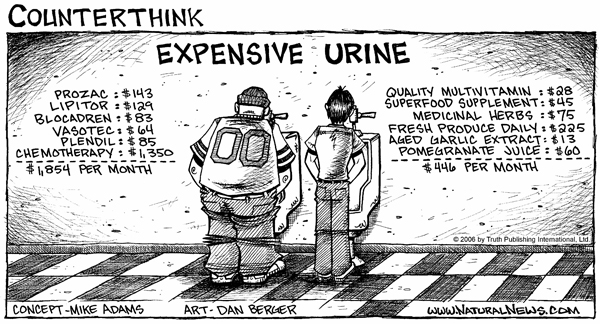
I thought this cartoon was another good response to the question I raised in my post a few days ago: Why do Americans eat junk food?


Mike Adams of www.NaturalNews.com comments that critics of proponents of organic foods, vitamin supplements, herbs and so forth often say that investments in such things only give people "expensive urine."
When it comes to really expensive urine, however, doctors fail to look at the cost of all those pharmaceuticals and chemotherapy drugs they're shoving down the throats of patients. Those drugs are excreted through the urine, too, and when you add up the cost of those (just the financial cost, not even counting the cost in devastating side effects), they far outweigh the cost of eating healthy foods and taking supporting supplements.

If you really want expensive urine, go see a doctor. Ten visits later, you might find yourself on ten prescription drugs. Your body will be a wreck, your mind will be half-lost, and you'll be peeing away twenty bucks in medications every time you visit the restroom.

And guess what? All those medications end up in the environment. Trace amounts of antidepressant drugs are already showing up in the public water supplies in cities around the world. Pharmaceuticals, it seems, not only lead to expensive urine, they also lead to devastating environmental consequences such as fish producing dual sex organs.
Adams' comment about finding yourself on ten prescription drugs reminds me of the doctor's letter to Dr. Jonathan Wright that I quoted about a month ago. If you don't remember, he began his letter by saying, "Last week, I saw a 55-year-old woman who is very, very sick due to insurance-covered treatment with patent medicines." --And he then lists the ailments that are close to killing her, one ailment after the other brought about by the symptom-only "fixes" prescribed by the woman's primary care physician.

Thursday, December 16, 2010

Making live-culture foods . . .

About two months ago it suddenly hit me. The way I expressed it at that time was, "I like acidic foods." I'm not sure I got that right. Maybe I should have said "tart" foods or "piquant" foods--spicy tomato sauces in or for pizza or spaghetti; spicy (though not overly-hot) salsa and/or picante sauces; sauerkraut; pickles; SweeTarts® candies; vinegary salads; kefir; yogurt; sourdough breads (the sourer the better!) . . . --If I'm eating spinach or broccoli: give me lemon juice on them. (Yum!) . . . Oh! And that makes me realize: Yes, I love almost all citrus fruits. I'll suck on a lemon with pleasure. Straight. Grapefruit. . . .

Ahh!

Probably two and a half years ago, now, Amy introduced us to Bubbies® naturally fermented sauerkraut and pickled cucumbers. They were good, though I have continued to prefer more "modern" sauerkraut.

Early this past summer, while I was visiting Amy and Phil in Virginia, Amy offered me some homemade kombucha--a fermented sweet tea.

Oh, wow! Very refreshing!

I have never enjoyed the flavor of alcohol. As I have told many people, it always makes me think of cough syrup. Yucky! (It seems that at least a couple of my kids have inherited the alcohol-tastes-yucky gene from me.)

And kombucha, apparently, can ferment to alcohol. At least slightly. But if Amy's komucha contained alcohol, it was very slight, and I enjoyed the flavor.

Late this fall I decided I would begin brewing my own kombucha. I have now made and consumed two full batches and am brewing my third.

Sarita hasn't joined me. But I enjoy it.

A few weeks ago, as I was in our local Vitamin Cottage/Natural Grocers, Sarita asked me to find some kimchi--the Korean equivalent to sauerkraut but made with almost any vegetables rather than cabbage either necessarily or primarily. (Kimchi can be virtually the equivalent of sauerkraut, but usually not.)

Anyway. After trying kimchi, and realizing that the local fresh fruits and vegetables season is at an end, we got to talking about how we might preserve the remaining organic vegetables we have on hand, and especially cabbage.

"What if we make our own sauerkraut?"

So that's what I did beginning about two weeks ago.
I chopped a head of cabbage into relatively fine pieces, then dumped them into the crock from our crock pot along with some sea salt; mashed the mixture down as well as I could (and I mean mashed it!); placed a saucer on top of the mash; mashed that down; placed a half-gallon jar full of water on top of the saucer to apply continual pressure; covered the entire apparatus with a clean towel; used a rubber band to seal the edges; and let it sit in the kitchen for about a week and a half.

Then, two days ago: voìla! Finished sauerkraut!

We ate some last night.

Good!

I'm hoping to learn how to make more such fermented foods with the capable coaching of Sandor Katz.
*****

A postscript.

Last week, while I was at the Acres USA conference in Indianapolis, it hit me: several speakers commented on how animals know what foods to eat for their health. If they are in need of a particular nutrient, they will seek out--somehow, naturally, through some "sixth sense," as it were, exactly the kind of plant or animal or whatever-it-is (even dirt!) that they need to ingest in order properly to nutrify themselves.

Is it possible, I began to ask myself, that I desire fermented foods because I could really use the bacteria--the "probiotics"--that inhabit them? Have I been "starving" myself, as it were, of the very things that would provide great benefits to my body?

--The hypothesis would certainly fit with what a lot of naturopathically-oriented people say: that people (like me) with autoimmune difficulties often suffer from "leaky gut syndrome" which, itself, is often the result of a poor biotic atmosphere in the gut . . . a problem itself that often arises from too much use of antibiotics earlier in life.

Well, with my asthma difficulties as a child, I received quite a lot of antibiotics just to keep me alive. I am sure they did their work. But I don't remember anyone ever worrying about re-seeding my gut with appropriate bacteria once the bad bacteria had been eliminated.

I wonder. . . .

Thursday, December 9, 2010

S510 back from the dead

Ay-yi-yi!
Looks like Monsanto, Cargill, and the other major industrial food suppliers may get their way and get “their own“ bought-and-paid-for food czar in charge of all food production in the U.S.

Speak of tyranny!
Please read S 510 Food Safety bill is still alive and may unleash a new army of FDA agents . . . and call your senators.
What‘s got me worked up?
  • Even with the Tester Amendment (that permits farms with less than $500,000 annual revenue off the hook), this law encompasses virtually any and every viable “real“ farm in America. --$500,000 revenue will hardly permit enough profit to support a single family, much less an operation that requires a non-family employee or two.
  • Constitutionally, according to the 5th Amendment, what is the U.S. Congress doing providing for the FDA to regulate local food growers/producers/distributors? If i grow fruits and vegetables (or meat or milk or any farm product) solely for sale to people in my own state, according to the 5th Amendment, the Congress ought not to be seeking to regulate my trade with my neighbors. (But, of course, the federal government has justified its infringements in these matters for decades. So I should probably simply acquiesce, right?)
  • The issue that Mike Adams emphasizes in the article I have highlighted here: the plan to move full regulation of food production to the administrative whims of individual bureaucrats who can be bought off by special interests--bureaucrats who can always hide behind the justification that they had “reason to believe“ that something might be harmful. No judicial review. No appropriate due process. Simply the decision of a new “food czar.“
And we think we live in “the land of the free“?

Wednesday, December 8, 2010

Why do Americans eat junk food?

I had heard this before, but Food, Inc. developed the theme with a brief look at the eating habits of one lower income family. "I can't afford good food," says the mother. It would be far better for her family--and especially her diabetic husband--if they were to eat vegetables, but a small helping of vegetables would cost more than a hamburger at a fast food restaurant. So fast food it is . . . as the family suffers the consequences of obesity and diabetes.

Reader's Digest featured a brief "Best of the Blogs" article in its October issue called Why That Salad Costs More than a Big Mac.

Look where federal food subsidies go--and then compare them to government dietary guidelines (which have problems themselves, but . . .)
Meanwhile, the government is proposing to take over our healthcare system. Who can afford healthcare nowadays, right?

But the largest factor in medical costs today? --The result of lousy nutrition.

So the federal government subsidizes not just poor nutrition, but actually debilitating nutrition . . . so that . . . what? It can subsidize the resulting necessary medical expenses?

Does this make sense?

Life Extension Magazine, October 2010 said,
Similar to the deferred effects of cigarette smoking, medical costs associated with obesity-related diseases are mostly postponed. This means that society has only begun to pay the enormous healthcare expenses that will accrue as overweight individuals succumb to cancer, vascular occlusion, kidney failure, diabetes, arthritis, early senility, and other illnesses.

The federal government’s meager steps to combat this calamity have failed. The evidence can be seen by the fact that nearly three times more Americans are obese today compared to 1960. A more startling statistic is that six times more Americans are morbidly obese (body mass index 40 and above) than in 1960.

Obese individuals (body mass index 30 and above) now comprise over one-third of the American population. Another one-third is overweight (body mass index of 25-29). The majority of Americans are thus destined to suffer higher incidences of degenerative diseases than this nation’s healthcare system can afford.
There's more, but I'll stop here.

Maybe those of us who can afford to eat properly ought to eat properly, despite government incentives to eat poorly. After all, it wasn't that long ago the average American family spent 30 percent or more of its income simply to eat. Few of us would need to approach anything close to that number to eat only healthy foods and all organic all the time.

But let us not "even" go that far. What if we "simply" modulate our intake of the truly awful "foods" (y'know, like soda pop, white-flour-and-sugar based sweets, French fries, potato chips and other similar deep-fried snacks), and what if we determined to eat at least half a pound a day, per person, of the cruciferous and deep green leafy vegetables? Those few changes might create a revolution in our personal health statistics.

Monday, December 6, 2010

Bacteria, sickness and health

Mike Adams of Natural Health News often makes side quips about the modern scientific and commercial food establishment's anti-bacterial fixation. The general viewpoint promoted by our society seems to me to match what Adams complains about: that the only good bacteria is a dead one. As he put it in his last article about S510, Top ten lies about Senate Bill 510:
Lie #8 - The FDA just wants to make food "safer"
Actually, the FDA wants to make the food more DEAD. Both the FDA and the USDA are vocal opponents of live food. They think that the only safe food is sterilized food, which is why they've supported the fumigation, pasteurization and irradiation efforts that have been pushed over the last few years.
Sounds about right to me (as far as the mentality of the FDA and USDA). But, I was reminded recently, the mentality is totally wrong from the perspective of the latest scientific discoveries.

My reference to Bonnie Bassler in my Microbes and Soil post was picked up by Keith Johnson on the Permaculturelist blog. And that yielded a comment by Doug Weatherbee that focused on the central point of Bassler's TED talk--something I didn't mention in my post--the significance of what Bassler calls Quorum Sensing:
Over the past 15 years Dr. Bassler and her MIT team discovered that all bacteria species "speak" in 2 chemical languages: one language is a private language only understood within the specific bacteria species and the other language is the Esperanto common language understood by all bacteria species. Until Dr. Bassler's work, microbiologists couldn't understand how some bacterial mixtures which contained pathogens like E. Coli would not show E. Coli virulence and other bacterial mixtures which contained E. Coli the E. Coli would be very active and engaging in a virulent attack. Dr. Bassler figured out that the E. Coli were communicating to other E. Coli using the private E. Coli chemical language AND communicating to ALL of the other bacterial species using the common bacterial language. Only when the E. Coli number of individual bacterium RELATIVE to the total of all bacteria species numbers was high enough in E. Coli to give the E. Coli a fighting chance of winning would the E. Coli "switch" on and become virulent. From an evolutionary standpoint this makes sense. Why would a pathogenic organism species make an attempt to create dis-ease (which entails a use of valuable energy) when it is completely outnumbered by other microbial species who may be potential predators who function as a check and balance against the disease.

This has profound implications for farming and ranching.
--And, I might say, to how we should approach a lot of medicine.

Weatherbee maintains his focus on agriculture (since that's his specialty; he's a Certified Soil Foodweb Advisor):
Whether our biocides are synthetic "chemical" pesticides or "organic" home-made pesticides, the thinking behind their use is the same: if the pathogen is present (even in a neighbour's field) we lay down a biocide attacking the pathogen. Our biocides, whether a commercial Syngenta pesticide or a homemade permaculture recipe for powdery mildew sulphur containing "organic" biocide, kills BOTH the bad-guy pathogen microbes and the good-guys.

Problem here is that the bad-guys usually (not always but usually) reproduce more quickly and come back before the good-guy microbes. Quorum Sensing points to a fundamentally new way of thinking about this in our farms. We need to increase the ratio of good-guy microbes in the soil and on the plant surfaces in relation to the "bad-guy" pathogen microbes. Research on plant pathogen suppression with composts backs this up. It's the amount of a plant pathogen species #s in a compost relative to the total pile of microbes that determines whether the plants will develop the disease. (Emphasis mine--JAH)
Well, the same relation exists in our bodies as well. As Barbara Minton notes in an article published on Mike Adams' Natural News site: "[T]aking probiotics is probably one of the best interventions you can do to stay healthy or regain your health. That's because those four pounds of little critters in your gut are to a very large degree your immune system. They hold the keys to your very existence."

I'm afraid Minton may be using an "old" and inaccurate metaphor for what occurs in our guts. For her, the "good" bacteria go to war against the "bad" bacteria:
Probiotics are friendly bacteria similar to those found in people's guts, especially in the guts of breastfed infants who have been provided this natural protection against many diseases by their mothers. Most friendly bacteria come from the Lactobacillus or Bididobacterium groups. There are several different species of bacteria in each group. Some probiotics are also friendly yeasts.

Taking probiotics is a way to keep your friendly bacteria population up to full strength so it is always at the ready to defend you. It is a way to replenish the bacteria that are killed off by the pesticides and chlorine. If you have taken antibiotics, taking probiotics is even more important because you probably have unfriendly microorganisms living in your gut that your reduced levels of friendly bacteria are having difficulty handling.
But I wonder if Bassler's view may be more accurate.

Perhaps what's happening is not so martial as the "old" probiotic model implies. Maybe the "good" bacteria never have to go to war at all. Rather, it's their fearsome countenance (sorry; I know I'm engaging in some anthropomorphism, here, myself; . . . --Maybe it's their overwhelming numbers, a bacterial form of what human militaries call deterrence) that, as Bassler's model suggests, "simply" dilute the more destructive bacteria's numbers enough that they never produce the "quorum" necessary to decide, "Let's go! It's time to attack!"